Rainbow Haven is a place of welcome, support and opportunity for displaced people living in Manchester, Salford, Trafford and surrounding areas. It is a place for all refugees, asylum seekers, and vulnerable migrants.
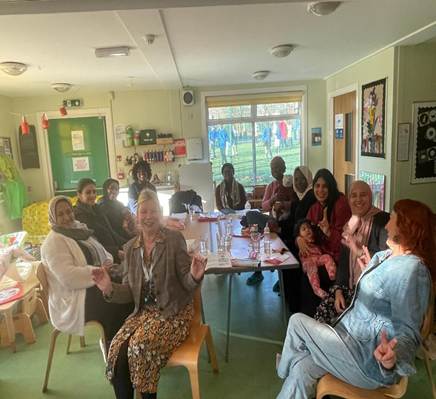
I was delighted to be invited back to do some health promotion around cervical screening on 3/12/25 for the ladies who attend the ‘Mama Group’. Health promotion empowers individuals and communities. A forty-two-year-old lady from Kurdistan who I met in June was immensely proud and informed me that after the visit in June she had attended her first smear test.
Another lady from Senegal had not had a smear test and her concern was that due to FGM, she did not feel she looked normal. An interesting conversation followed on FGM. The ladies did not know the terminology FGM, but used words such as cutting, hatching, Suma and circumcision. I reassured them that there is no judgement and a supportive environment is made, especially if it is a patient’s first smear test National FGM Centre
I encouraged all the ladies there to go home and get their mirrors out and to look at what is normal for them. This led me to discuss vulvar cancer and the signs and symptoms to look out for. Vulval cancer is a rare cancer. Around 1,400 people are diagnosed in the UK each year. The risk of developing vulval cancer increases as you get older. On average each year more than 40 out of 100 (more than 40%) new cases are in women aged 75 and over. Almost 70 out of every 100 vulval cancers are caused by HPV infections.
There are many different types of HPV, and some are more likely to cause vulval cancer than others. The most common types of HPV related to vulval cancer are:
- HPV type 16
- HPV type 33
- HPV type 18
This led on to an opportunistic conversation of the importance of immunisations.
The HPV vaccine helps to protect against HPV infections. All children aged between 11 and 13 in the UK can get the HPV vaccine. It is also offered to some people in older age groups too.
The NHS invites women for screening five years depending on their age, or more frequently if the high-risk human papillomavirus (HPV) is detected, with the programme saving thousands of lives annually.
The NHS Cervical Screening Programme, England 2023-2024 annual report, published by NHS England today, found that 68.8% of 25 to 64-year-olds were screened within the recommended period, compared to 68.7% the previous year. Coverage was higher for 50 to 64-year-olds at 74.3% compared with 25 to 49-year-olds at 66.1%. Women nationally are being urged to attend there cervical screening appointment as five million women are not up to date. NHS cervical screening helps prevent cervical cancer by using a highly effective test to check for HPV, which is found in over 99% of all cervical cancers and which may cause abnormal cells to develop in the cervix. These abnormal cells can, over time, turn into cancer if left untreated.
We discussed checking your breasts and advised to stand in front of the mirror looking for any changes.
It was a wonderful, positive, and informative afternoon and individually the ladies had the opportunity to ask about individual problems.
Permission given by participants to use for SPCT.